Sunday, March 8, 2009

So you want to learn Karate? Welcome to my dojo!

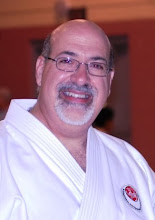
I am the Sensei or teacher in this class and I hope that you have a wonderful experience that will help you to enjoy martial arts as much as I do! That is how I greet new students. Of course, it may not be verbatim but you get the idea.

In the first class at my dojo, there are many things that you will learn. You will learn some of the history of the Shotokan Karate and some of the principles or precepts that come with our style (also known as the dojo kun). The amount of time spent discussing these things depends upon the age of the student, and their attention level. Younger students get a little less history at a time, since they have a shorter attention span. As we progress through the traditions of our class-like rei-ing in (bowing in), we discuss those too.

It is important not to overload any student. So I keep a good watch on the student's expressions and body language. After all, my goal as a teacher is to inspire and ignite a passion for the martial arts. So I don't want to talk too long, as I don't want to lose them. So after a bit of talk about history, dojo rules and traditions we begin training.

It is customary in my dojo to warm up with some stretching. It doesn't matter if it is a beginning class or a more advanced class. Then I introduce some techniques. While demonstrating the techniques, the proper form is explained. I try to pattern my teaching after the way I was taught by my Sensei. I give a lot of encouragement to my students. As time goes on with a student, a balance is reached that includes encouragement and constructive feedback. During a first class, though, we concentrate on encouragement.

The first techniques that are learned in my dojo are dachis (stances). Our foundation is built upon our connection to the earth and so it is very important that we are able to stand correctly. We generally cover just the most basic of stances in terms of practicing those techniques, although some of the others to be taught later are demonstrated. We spend some time practicing what we have learned and then we learn to walk using the stances. Usually, I concentrate on moving in zenkutsu dachi (forward stance) since it is one of the most commonly used stances.

Moving into the next technique, I teach a choku zuki - straight punch. After a bit of practice in slow motion, we speed it up a bit. Then we are ready to try to put stance, movement and strike together. So we drill with our zenkutsu dachi (forward stance) and walking, rooting ourselves and then executing choku zuki - straight punch.

The first class with a student usually consists of these things and bowing out ceremony. On paper, this may not seem like it would take a great deal of time, but it actually works out to be about one class period. Of course it depends upon the age of the students, whether or not they learn quickly and various other factors.

Students are welcome to stay after and ask questions. Sometimes we spend a little bit of time processing what is learned and I encourage them to practice daily. I am also open to being called if there are more questions that come up later and email is always an option. My purpose as a teacher is to pass on what I know and my love of the art. It is my mission and passion. I look forward to teaching each person who takes the time to come to my dojo. Hopefully, the experience they have with me will inspire them to continue into the do (way of life) and enhance their life.

Tuesday, March 3, 2009

Martial arts - at my age?!

Maybe you can't picture yourself kickboxing your way to fitness or mimicking moves you've seen in old Bruce Lee films, but the vast world of martial arts disciplines has something to offer just about everyone.

A martial art is an Oriental art of combat or self-defense practiced with or without weapons. People who study martial arts in the U.S. today do so mostly for sport, self-defense, and exercise, as well as to develop concentration, self-confidence, and self-discipline. Karate is one of the more popular martial arts in the U.S.


Kicking It Up A Notch
If you're looking for a more physically intense martial arts experience, consider Karate which is one of the better known martial arts that involve varying degrees of kicking, punching, blocking, striking, and self-defense techniques.

All martial arts, regardless of style, can help develop strength, balance, and flexibility, and improve concentration and confidence. Martial arts are the best for helping older people develop and maintain strength and balance.


Because the martial arts are progressive, you won't start out kicking to your head and breaking boards with your hands, regardless of how old you are. With time and practice, you'll reach higher and higher levels of expertise at your own pace.

Studying a martial art can challenge you both mentally and physically, teach you about different cultures and philosophies, and provide a new outlet for physical activity that can last for years, depending on how much you want to learn and how far you want to advance.

Friday, December 19, 2008

Dojo Etiquette
by Master Teruyuki Okazaki

In the last Spotlight , I finished Master Funakoshi's Niju Kun and now it is time to discuss rei gi saho, or dojo etiquette. As Master Funakoshi states, "Without courtesy you cannot practice Karate-do."

This applies not only to our training but to life in general.


The word "dojo" is actually two words. "do" which means "the way" or "the path" and ‘jo’ which means ‘the place’. When the two words are combined it means "the place where the way is studied’. The dojo is the place where we learn to live together as human beings. This is a serious subject and therefore we must always follow dojo etiquette.

This is the first step to practicing Karate-do.

Upon entering the doorway of the dojo, face shomen side, and bow. This is called ritsu-rei and shows deep respect to the teachings of Master Funakoshi as well as the seriousness of your study. Always try to arrive to class 10-15 minutes early so you have time to stretch and practice.

When the instructor says line up, move as fast as possible to form the line. Remember, more than two steps, you must run.

When making seiza, always go down left knee first, then the right knee. The hands should rest comfortably on the thighs. Sitting in seiza is much more than just kneeling. Historically, the samurai always had to be ready to defend themselves at any time. Since the sword was always carried on the left hip, the left knee went down first so they could draw the sword without injuring themselves. Always keep both balls of the feet in contact with the floor when kneeling down or rising to the standing position. If your posture is not straight and your feet not gripping the floor, then it is almost impossible to effectively defend against an opponent. Try this for yourself. After making seiza, then you must close your eyes in mokuso. This term means to cleanse or make blank your mind to prepare for training. You have to forget all your thoughts and concentrate only on what the instructor is trying to convey. By only existing in the moment can you really learn.

After the command mokuso yame, open your eyes. Shomen ni rei- bow to the shomen side, Sensei ni rei, bow to the instructor. Every time you bow push your ego further down and become as empty as possible. Next issue we will discuss dojo manners during class.


SAFETY FIRST.
No horse play.
Practice good distance and control with your partner.
Notify the instructor of any injury or illness.
Keep toe and finger nails short.
No jewelry.
No gum, candy, or food during training.
Drink water.

RESPECT ALWAYS.
Arrive on time in a clean body and gi; be prepared to train.
Bow before entering the training floor.
Bow when facing/leaving a partner.
Train with enthusiasm and strong spirit.
Do not disrupt the class by talking.
Do not delay class: move to a new position quickly; ask only brief questions.
Maintain good posture with hands at your sides; do not lean or lounge.
Turn away from shomen (front of training area) or your partner when making adjustments to your gi, sneezing, coughing, etc.
Notify the instructor of extended absence.
Keep your dojo clean.

Sunday, October 19, 2008

THE FOUR CORNERSTONES
The building blocks of karate
As with anything of substance Shotokan karate is based upon a strong foundation.


Like a forty-two story office building standing tall and proud, Shotokan karate is supported by four cornerstones without which it could not have stood the test of time. These four building blocks are: a proper stance, proper posture, proper balance and proper "kime" or focus.

Without these four basic building blocks working in harmony with each other, equally weighted, and equally given their due, you will never learn to develop your techniques to their full potential, and thus you will never have any hope of truly understanding let alone mastering, the art of Shotokan karate.

STANCE
Your stance is the platform upon which everything else is built.

It is the beginning, middle, and end of all that you will do as a Shotokan karate-ka. More than any other style of karate Shotokan is noted for it’s long low stances which, when practiced correctly, are very effective at creating a low centre of gravity, promoting good stability, and fostering strong muscular development.

Early on in your karate training you will quickly be made aware of the fact that landing in a poor stance, however momentarily, will create a level of instability that will prevent you from making any effective defensive or offensive movements, while at the same time you will be leaving yourself open to a successfully attack or counter attack from your opponent.

Given such an opening even a junior belt properly trained will seize upon the moment and may be virtually assured of victory due to your lack of stability and strength.

Without a proper stance nothing else is possible.

POSTURE
Your posture says it all.
From walking down the street, to sitting in a business meeting, or simply driving in your car. In your daily life how you carry yourself says a lot about who you are. Throughout our early childhood we were all told to sit up straight, to stand up properly, to keep our head up, and to watch where we were going. Today how you personally hold yourself, how you carry yourself when you move, and how you focus on your surroundings, depends largely on how well you have taken these early lessons to heart.

In Shotokan karate it is vital that you learn to always center your torso over your hips when you move. If you can remain conscious of this fact, especially when shifting from one stance to another, then by combining good hip movement with proper posture and balance you will create a strong vertical center, thus making smooth rapid movements possible and effective.

The hips should be considered the steering wheel of your body.

You will quickly come to learn that poor posture equates to poor everything else.


BALANCE
Good balance is the result of a proper thought.

In karate from the moment you start to move from one stance to another, or from one technique to another, you are essentially risking all that you have in the hope of achieving something better. This period of transition often lasts for less than a split second of time, a time in which balance plays the role of the sun, acting as the center of your universe around which all of your other actions must revolve. Without proper balance a successful out come in anything karate related is virtually impossible.

Balance, however, can never be achieved unless the scales are even. While your technique and skill will weigh heavily on one side of the scale, they must in turn be equally balanced by the mental and spiritual side of your being. In karate trying to perform any movement or technique requires a level playing field, one in which each function must be awarded just the right amount of concentrated effort necessary to make the whole thing work as you intended it to.

Balance is the sum of all movement added together.

Only when the body, mind, and spirit are in complete harmony can proper balance be achieved.


KIME
Kime is the sum of all your efforts.

The concentrated focus of all your physical, mental, and spiritual actions combined at a specific moment and place in time is called kime. The moment you make any kind of movement in karate your true level of kime will be reflected in the accuracy and quality of your techniques and any errors in judgement will then be clearly visible for everyone else to see. If your kime is found lacking then in effect nothing you just did should be considered real. No amount of strength, no amount of speed, and no amount of kiai can ever make up for a lack of kime.

In your training you must believe in what you are doing, and that belief must have a definitive beginning and ending, an ending that you will find you can only reach by putting all of your other thoughts aside and focusing for as long as it takes to achieve your goal. Without this all encompassing belief in the success of what you are attempting to do your techniques will become nothing more than physical actions without any mental substance, in a world where mental substance is often the difference between victory or defeat.

Without kime your karate has no value.

Kime is only effective when nothing else matters.
So there you have it, the four basic fundamentals without which your karate will not develop properly.

So train hard, train often, and make these fundamentals the basis for everything you do in the dojo.


Remember - Stance, posture, balance, and kime,
are the foundation upon which you must build
.

Sunday, October 12, 2008

Flexibility is very important to all sports including karate. There are a number of very important reasons to include regular stretching into your fitness routine.
Injury prevention:

By lengthening the muscle you are decreasing the risk of tears and strains, as the muscle will be better able to cope with stresses over a larger range of movement.

Increased skill level: Your joints will be freer making it easier to focus your technique in the correct position.

Increased speed: Longer muscles means less resistance to the technique, especially for those high kicks.

Increased strength: Due to the length tension relationship, as the length of the muscle increases so to does its strength over a fuller range of motion.

Each stretch should be held for at least 30 seconds on each side. You may want to repeat the individual sequences a number of times to get the maximum benefit. The secret to getting results is consistency. If you spend half an hour, three times a week stretching, then you should begin seeing improvements very quickly. Give yourself a day to recover after a heavy stretching session to allow the muscles to grow and lengthen.

Sunday, October 5, 2008

What's the benefit of practicing Kata?

There are a number of benefits that directly relate to the practice of kata. Some of these benefits are:

1. Self defence lessons
2. Learning and remembering your kata
3. Reinforcing basics
4. Physical fitness
5. Improving your concentration and focus
6. Improving your coordination
7. Relaxation and enjoyment


When practicing kata your opponent must be real in your mind.

You must block his attacks strongly and you must destroy him with your counter attack. This is the only way to get true self defence value from kata.

Rote learning is a learning technique which avoids understanding of a subject and instead focuses on memorization. The major practice involved in rote learning is learning by repetition. The idea is that one will be able to quickly recall the meaning of the material the more one repeats it.

Rote learning of kata teaches the pattern and the basic movements that are required to perform the kata. Continued repetition refines your techniques.

Kata is full of basic techniques. Applying basics in a self defensive situation needs to just happen. The only way it can “just happen” is to teach the subconscious what to do in times of stress. The only way to do that effectively is through repetition of the basic techniques.

To build cardio vascular fitness you only need to practice your kata. Practice kata, three hard with full speed and power and then one soft to catch your breath and relax. By performing the kata softly I mean performing the kata with little or no power but still performing the kata technically correct.

Concentration and focus is improved by your having to remember and correctly perform the kata. Only practice can achieve this.

Your coordination is improved by your brain having to continually make you use both sides of your body to perform intricate movements which become more and more complex with each kata we learn.
You should enjoy performing kata. Do not see the performance of a kata as a task so much, but rather an opportunity to immerse yourself in the deeper meaning of the kata from a meditation perspective. You become the kata and the kata becomes you in your performance.

You will get to a point in your pursuit of Karate-Do where you move beyond the physical in the performance of your kata. Seeing the beauty within the kata is a personal progression where mind and body become truly one, and the performance of the kata is art in itself.

Sunday, September 28, 2008

Speed, Speed, Speed…
Power that is instantaneous and formidable!

In a decisive technique, there is a power that is instantaneous and formidable. The basic techniques of Karate are influenced to a very great extent by speed. It may be a bit of an exaggeration to that in training in techniques, speed is first in importance and second in importance, but it is no exaggeration to say that the objective if basic training is maximizing speed.

Since the body is organized in thee basic parts, power comes from increasing speed in all of them. If the muscles involved are contracted as fast as possible, then the power that reaches the hand in punching, in order to take advantage of the pairing of forces that comes from withdrawing the other arm, it must be with drawn as fast as possible.

Speed is dependant, for one thing, on muscle control. When certain muscles contract, other muscles expand. In punching, for example, the triceps expand while the biceps strong contract. If proper coordination between the expansion and contraction is lacking, then the movement of the arm will not be smooth and an effective punching technique is not possible.

Beginners have a tendency to use unnecessary muscles. As a student, you must accept guidance and, according to your training, learn to control your muscles.